
Look, it's a fair question. When someone tells you they're bringing medical equipment into your home or aged care facility, one of the first things that crosses your mind is, "But is this actually safe?"
It's a completely reasonable concern. And honestly? It should be your first question.
Our team has been working in mobile healthcare for years, and we've walked into plenty of rooms where someone's clearly thinking, "This person just came from who knows where with that equipment." The worry is written all over their face.
Here's what we've learned from doing hundreds of mobile scans and working alongside radiographers who handle X-ray equipment daily. Infection prevention in mobile healthcare isn't just about following protocols. It's about realising we're entering your safe space, and we have a responsibility to keep it that way.
What You Really Need to Know
- Mobile healthcare can actually reduce your infection risk compared with hospital visits, but only when it's done right
- The biggest infection risks aren't what most people think they are
- You have more control over your safety than you might realise
- Not all mobile providers follow the same standards, and that matters more than you'd think
Ready to learn how we keep you safe?See our infection-safe mobile services
Why Mobile Healthcare Can Actually Be Safer (When Done Right)
Here's something that might surprise you. According to the Australian National Health and Medical Research Council, approximately 165,000 Australians develop healthcare-associated infections every year. Most of these happen in hospitals and clinics.
Think about it for a second. When you go to a hospital, you're sitting in waiting rooms with people who are genuinely sick. You're touching surfaces that hundreds of others have touched that day. You're breathing the same air as someone who might be coughing two seats over.
Mobile healthcare removes all of that, but it creates different challenges.
The thing is, we're bringing sophisticated equipment into environments we can't control. Your home might have pets. The aged care facility might have residents sharing common areas. And honestly? Sometimes we walk into places where the cleanliness isn't quite what we'd hope for.
But here's what our sonographers and radiographers have learned after years across hospital and mobile care. When mobile healthcare is done properly, it's much safer for the patient.
The Real Infection Risks (And They're Not What You Think)
The Phone Problem Nobody Talks About
Want to know something that catches most people off guard? A study found that 98% of hospital staff phones harbour bacterial contaminants, including MRSA, the superbug everyone's afraid of.
And here's the kicker. About 90% of staff never clean their phones.
Picture this scenario, which our team has seen plenty of times. A technician touches a contaminated surface in someone's home, then touches their phone. Even if they wash their hands afterward, the moment they pick up that phone again, their hands are re-contaminated.
It's a cycle of contamination that can spread from patient to patient.
That's why, at Modia Health, we have strict protocols about personal devices during patient care. It's not just about the obvious stuff. It's about recognising the hidden pathways most people never think about.
Respiratory Infections: The Invisible Threat
In aged care facilities especially, respiratory droplets from flu, COVID-19, or bacterial pneumonia can survive on surfaces for hours, sometimes days.
Our team has worked in facilities where residents share dining areas and the approach has to be extra careful. These pathogens pose particular threats when people are living in close quarters.
According to the Australian Department of Health guidelines (updated March 2024), that's why we use advanced PPE protocols and specialised disinfection procedures for all surfaces that come into contact with or are near patients.
IV Therapy: Where Zero Tolerance Really Means Zero
For patients receiving IV antibiotics, hydration, or other infusions at home, bloodstream infections represent the most serious risk. These can range from localised site infections to life-threatening sepsis.
Here's where the science gets really specific. A meta-analysis of 9,689 catheters found that chlorhexidine-based solutions were significantly more effective than povidone-iodine in preventing catheter-related bloodstream infections.
That's why we use 2% chlorhexidine in 70% alcohol for skin preparation, as recommended by the Australian Guidelines for the Prevention of Catheter-Related Infections. It's not just about following protocols. It's about using the most effective methods available.
We also use ultrasound guidance for difficult venous access, which reduces the number of insertion attempts. Fewer attempts mean less trauma to the skin and lower infection risk.
How We Actually Protect High-Risk Patients
Immunocompromised Patients Need a Different Approach
Cancer patients, transplant recipients, people with immune disorders. They can't afford to take chances.
From working with these vulnerable populations, our team has found that it all starts with scheduling and communication. We need to determine the specific requirements of each individual and the equipment we'll need.
We use additional equipment barriers, upgraded PPE, and allow for extended room ventilation time. The approach has been developed alongside oncologists and infectious disease specialists from regional hospitals, so we're always aligned with the latest evidence-based practices.
NDIS Participants: Every Person Is Different
People with disabilities often have unique healthcare needs that require individual infection prevention strategies.
Some NDIS participants have ventilators or feeding tubes. Others might have sensitivities that affect how we approach hand hygiene or equipment sanitisation.
This is where we develop what we call "person-centred" infection prevention plans. We accommodate different communication needs, adapt our techniques based on mobility or positioning requirements, and we educate and include support workers in the infection prevention process.
According to the NDIS Commission, support workers can use core supports budget to purchase PPE, which helps protect both worker safety and participant safety.
What You Can Do (And It's More Than You Think)
Here's the thing about infection prevention in mobile healthcare. You're not just a passive recipient of care. You're actually a key part of keeping things safe.
Research shows that in home healthcare, a significant portion of the actual care and infection prevention rests on patients and their informal caregivers, people who often lack formal training. That can be a major risk factor if it isn't addressed properly.
But when patients and caregivers are properly educated and engaged, outcomes improve dramatically. Here's what actually makes a difference:
- Practise hand hygiene together, before and after care
- Speak up if you're unwell, and let us know if you or anyone at home is sick
- Keep pets out of the room to create a clean, distraction-free space
- Clear the space by removing clutter so we can set up and move safely
We also use something called the "teach-back" method. Instead of just asking "Do you understand?", we might ask you to show us how you'll clean an infusion site, or explain the instructions in your own words. That confirms understanding and increases compliance, leading to better outcomes.
Behind the Scenes: What Actually Happens During a Mobile X-Ray
Here's a walk-through of what actually happens when our team comes to do mobile imaging. This isn't the sanitised version you might read in a brochure. It's the real process.
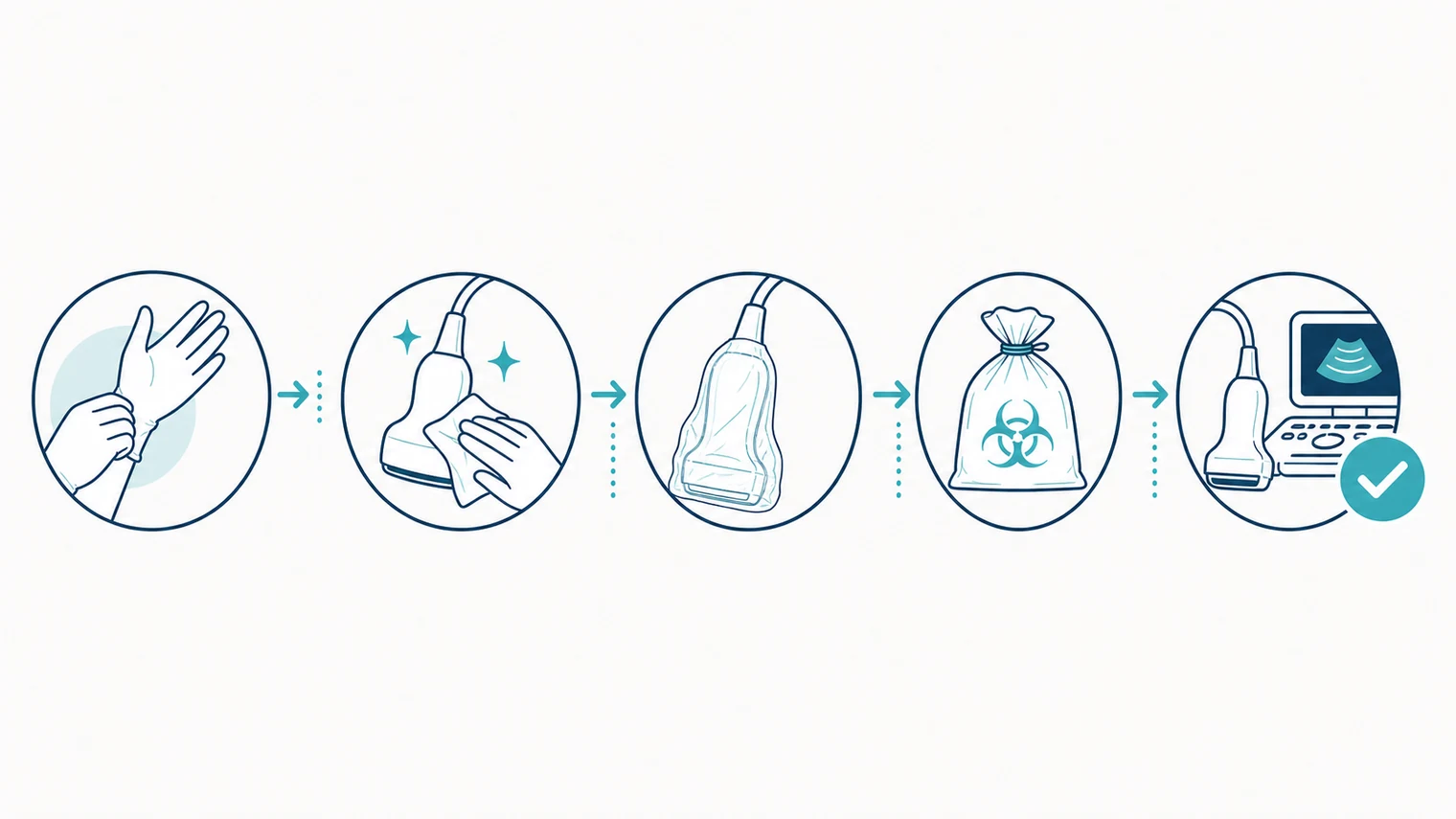
Before we even enter: We wipe down all external equipment surfaces with hospital-grade disinfectant. Yes, even after the initial deep cleaning process, because equipment gets transported in cars, moved through hallways, and touched by multiple people.
Fresh PPE every time: Our team performs hand hygiene and puts on fresh personal protective equipment before entering your care environment. Not the same gloves from the last patient. Fresh everything.
Equipment protection: We use specialised equipment covers for our detectors. It's an extra step that some providers skip, but it keeps things clean and reduces contamination risk.
Real-time documentation: We keep a daily record of equipment cleaning and disinfection routines. There's a clear, trackable history for each process. If something goes wrong, we can trace exactly what happened and when.
Post-procedure breakdown: After imaging, contaminated items go into designated containers. Equipment goes through multi-step cleaning. We document every step before moving to the next location.
It's methodical, it's thorough, and honestly? It's more detailed than what happens in some hospital settings.
The Mistakes Facilities Make (And How to Avoid Them)
After working with many aged care facilities and seeing how different providers operate, our team has noticed some common mistakes that put residents at risk.
The biggest one? Facilities underestimate how flexible a mobile imaging company should be willing to be. Some providers are very strict. "We can only do it at this time or you won't get it." That's not how quality care works.
Communication breakdowns are another huge issue. Some providers don't schedule scans for a long time, leaving facilities wondering what's happening. There's confusion, delays, and a lot of chasing up.
Here's what should happen. Scheduling should be within 24 hours. The facility should know when the scan's going to be completed. There should be a clear service timeframe that everyone understands.
The team knowledge gap is also a real problem. The clinical coordinator should brief all nursing staff. They should know who they're working with, what the protocol is, what the costs are, and how to book. They should also know where results are going to be sent and how to access the portal for images.
When the clinical team doesn't have a shared understanding of how it all works, that's when things go wrong. And when things go wrong in infection control, that's when people get sick.
Why This Actually Matters for Your Health
The Centers for Disease Control and Prevention estimates that effective infection prevention programs could prevent up to 70% of infections, leading to potential savings of up to $31.5 billion annually.
But for you, sitting in your home or aged care facility, those numbers don't mean much. What matters is this. Proper infection prevention can literally save your life.
Our team has seen what happens when protocols aren't followed. We've also seen the relief on someone's face when they realise they can get the care they need without putting themselves at unnecessary risk.
Mobile healthcare, when done right, gives you the best of both worlds. Professional medical care without the infection risks of crowded healthcare facilities.
Looking Forward: How Technology Is Making Things Safer
The future of infection prevention in mobile healthcare is moving toward what experts call an "unmanned, intelligent" model. AI and machine learning are starting to change how we predict and prevent infections.
AI-driven risk scores can analyse patient data to predict infection risks early, allowing for proactive interventions. In a mobile setting, this could mean an AI model recommending a catheter change before an infection occurs.
Telemedicine is also becoming a key tool. It reduces the need for in-person visits, especially for high-risk patients, while extending infection prevention expertise to geographically dispersed settings.
But here's the thing. Technology is only as good as the people using it. The fundamentals (proper hand hygiene, appropriate PPE use, thorough equipment cleaning) will always be the foundation of safe care.
Ready for Healthcare That Actually Keeps You Safe?
At Modia Health, we believe you shouldn't have to choose between getting the care you need and staying safe from infections.
Our full infection prevention program isn't just about meeting minimum standards. It's about exceeding them. Because when it comes to your health and safety, "good enough" isn't good enough.
We've built our protocols on real-world experience, evidence-based practices, and a genuine understanding that we're entering your safe space. We take that responsibility seriously.
Book Safe, Professional Mobile Healthcare Today
For Home Visits:
Book Home Service. Hospital-grade safety in your own home.
For Aged Care Facilities:
Book Facility Visit. Specialised aged care protocols.
Learn More About Safe Mobile Healthcare
Explore Our Safe Services:
- How Mobile Ultrasound Works. Technology and safety overview.
- Mobile IV Therapy Services. Safe infusion protocols.
- Mobile X-Ray Services. Imaging safety standards.
- Ultrasound Preparation Guide. Pre-scan safety tips.
Please note: All infection control protocols are aligned with the Australian Commission on Safety and Quality in Health Care standards and updated based on guidance from the Aged Care Quality and Safety Commission, NDIS Commission, and state health departments.
Disclaimer: This information is for educational purposes only and should not replace professional medical advice. Always consult with qualified healthcare providers for proper diagnosis and treatment recommendations.


